
Hair can look glossy after oiling and still break when you brush it. A product can make your strands feel thicker without increasing the number of hairs growing from your scalp. These differences explain why some hair oils deliver satisfying results while others disappoint.
The best hair care oils serve different purposes. Some help protect fragile lengths. Others add a polished finish. A few have early research suggesting potential benefits for hair growth, but the formula and quality of the evidence matter.
Recent studies have also made the picture more interesting. Research published in 2024 found that several plant oils could penetrate hair fibers and improve resistance to repeated stress in laboratory testing. Coconut oil remains useful, but the idea that it’s the only oil capable of entering hair is too simple.
Here’s how to choose an oil that earns its place in your routine.
Best Hair Care Oils: Which One Matches Your Goal?
These recommendations consider research, application, and practical trade-offs. They compare ingredients rather than assuming that every product containing them performs equally well.
| Oil | Most useful reason to consider it | Who may prefer it | Main limitation |
|---|---|---|---|
| Coconut | Pre-shampoo protection against protein loss | People with brittle or damage-prone lengths | Can leave fine hair heavy or coated |
| Argan | A finishing option for dry-looking ends | People who want a small amount of shine | Regrowth claims lack strong support |
| Jojoba | Simple conditioning in small amounts | People who prefer a minimal routine | Claims about balancing scalp oil are unproven |
| Camellia | An alternative with laboratory evidence for fiber protection | People interested in trying another plant oil | Limited evidence from everyday consumer use |
| Safflower | Another option with laboratory evidence for fiber protection | People comparing alternatives to coconut | No established hair-regrowth benefit |
| Rosemary | A scalp ingredient with limited human growth research | People considering an optional scalp product | Results from studied formulas don’t apply to every blend |
| Castor | A rich coating with possible shine benefits | Coarse lengths that tolerate heavier products | Thick texture and weak evidence for growth |
The evidence is strongest when the claim stays specific: protecting the hair fiber, improving its appearance, or investigating growth. Those outcomes shouldn’t be treated as interchangeable.

Understand Growth, Length Retention, and Shine Before Buying
A useful hair oil needs to match the problem you’re trying to solve.
Hair growth happens at the follicle. A convincing growth claim requires human studies measuring relevant changes over time.
Length retention describes keeping more of the hair you grow. If your ends repeatedly snap, protecting them may help your hair become longer without changing its growth rate.
Shine and softness are cosmetic results. They can make a worthwhile difference to your routine, even when they don’t indicate stronger strands or new growth.
This gives you a better way to assess a bottle. Instead of asking whether it “works,” ask what it has been shown to do and whether that outcome matters to you.
1. Coconut Oil for a Practical Pre-Shampoo Treatment
Coconut oil is a sensible first option for dry, brittle lengths because its reputation has support beyond traditional use.
A study comparing coconut, mineral, and sunflower oils found that coconut oil reduced protein loss in damaged and undamaged hair. Its chemical structure helps it interact with and penetrate the hair shaft. This supports its use for protecting existing strands, rather than proving that it accelerates follicle growth.
How to try it: Apply a thin coating to your mid-lengths and ends before shampooing. As a practical starting point, leave it for about 20–30 minutes once a week, then wash and condition normally. That timing isn’t an established optimum.
Fine hair may need very little. Dense hair may benefit from sectioning so the product spreads evenly.
If your hair feels stiff or requires repeated washing afterward, reduce the amount or change formulas. More oil doesn’t necessarily mean more protection.
2. Argan Oil for a Polished Finish
Argan oil is worth considering when your priority is the appearance and feel of your ends.
Keep the promise modest. A 2022 systematic review found insufficient evidence supporting argan oil for the hair-growth and hair-quality outcomes it assessed. That doesn’t mean you can’t enjoy an argan-containing finishing product; it means broad claims about rebuilding or regrowing hair need stronger proof.
How to try it: Spread one drop across your palms and skim it over dry ends. Assess the result before adding another.
Pay attention to the full formula. A silicone-based serum featuring argan oil can feel quite different from pure argan oil. Its finish comes from the combination of ingredients.
Choose according to how your hair looks, moves, and washes, rather than simply the ingredient highlighted on the front.
3. Jojoba Oil for a Simple Conditioning Experiment
Jojoba oil is technically a liquid wax. Consider it an optional conditioning ingredient rather than a solution for thinning hair.
It may appeal if you want a straightforward product for occasional use on your ends. However, “lightweight” is relative: even a small amount can overwhelm very fine strands.
How to try it: Test a drop on one section of your ends first. Compare that section with the rest of your hair before applying it everywhere.
Be cautious with claims that jojoba automatically regulates scalp oil production or clears follicles. Its presence in a formula doesn’t establish those effects.
If your roots are oily but your ends feel rough, you can apply the product only to the lengths. Your scalp doesn’t need oil simply because your ends do.
4. Camellia Oil as an Alternative Worth Considering
Camellia oil has a more interesting research basis than a simple “vitamin-rich” marketing description suggests.
A 2024 laboratory study examined coconut, Camellia oleifera, and safflower oils. The tested oils penetrated hair and improved single-fiber fatigue strength, meaning how well a strand withstands repeated stress before breaking.
That makes camellia an option to consider for conditioning damage-prone lengths. It doesn’t establish how much less breakage you’ll experience at home.
How to try it: Choose a small bottle or a finished hair product and introduce it on one wash day. Keep the rest of your routine consistent so you can judge the difference.
Check the botanical name if you’re buying specifically because of this study. Products marketed as “camellia oil” aren’t necessarily identical to the oil tested.
5. Safflower Oil for Another Approach to Fiber Protection
Safflower oil also featured in the 2024 penetration study.
One useful finding was that greater penetration didn’t automatically produce better fatigue-strength results. Coconut penetrated more, but the researchers didn’t find a significant difference in fatigue performance between the three tested oils.
For shoppers, the implication is practical: don’t choose solely on a claim of “deep penetration.”
How to try it: Use a small amount on your lengths as an occasional pre-shampoo treatment, then assess manageability and residue.
Keep safflower and sunflower separate when comparing research. They’re different oils, and findings about one shouldn’t be transferred to the other.
Safflower is an alternative to explore, not an established treatment for hair loss.
6. Rosemary Oil for Growth Claims That Need Careful Reading
Rosemary has human research behind it, but the evidence doesn’t support treating every rosemary product as a proven regrowth treatment.
A 2015 trial compared rosemary oil with 2% minoxidil in 100 men with pattern hair loss. Both groups showed increased hair counts after six months, with no statistically significant difference between them. That finding doesn’t prove equivalence, particularly because there was no placebo group.
What Did the Newer Rosemary Trial Add?
A 2025 trial involving 90 participants reported improvements in growth-related measures with rosemary-containing blends compared with coconut oil over 90 days.
However, it tested mixtures, including a formula containing numerous ingredients. The study was manufacturer-funded, and one author worked for the manufacturer. These factors limit what we can conclude about rosemary alone. The article also has a published 2026 correction.
How to try it: Choose a finished scalp product with clear directions. Don’t assume a homemade blend matches a clinical formulation.
Never apply undiluted rosemary essential oil directly to your scalp. Essential oils can cause irritation and allergic contact dermatitis.
7. Castor Oil for a Rich Coating, With Modest Expectations
Castor oil’s thick consistency can appeal to people who enjoy heavier products on coarse, dry ends. That texture can also make it difficult to distribute and wash out.
A 2026 narrative review discusses possible biological mechanisms related to hair growth, but proposed mechanisms don’t establish that ordinary topical castor oil reliably regrows hair. The review also notes reported cases of contact dermatitis and hair felting, or severe tangling.
How to try it: Begin with a trace amount on detangled ends, or choose a lighter finished blend.
If your main concern is visible thinning, castor oil’s popularity isn’t a strong reason to prioritize it. A rich coating and a fuller-looking strand are different from increased follicle activity.
What the 2025 Fermented Grapeseed Oil Study Actually Means
Fermented oils are an emerging area of hair-care research.
A 2025 study found that a specially fermented grapeseed oil penetrated chemically damaged hair more effectively and improved mechanical properties in laboratory testing. It also helped slow color loss under the conditions studied.
This is promising formulation research, but it doesn’t establish that:
- Ordinary grapeseed oil produces the same results.
- Every product labeled “fermented” uses the tested ingredient.
- The ingredient stimulates hair growth.
- A home fermentation method is suitable for cosmetic use.
The useful takeaway is that processing and formulation can affect performance. An ingredient name alone doesn’t tell you everything about the finished product.
You don’t need to replace a comfortable, effective routine each time a new laboratory paper appears.
How to Choose the Best Hair Care Oils for Your Hair
Start with the concern you notice most.
For brittle lengths: Coconut oil is a reasonable first pre-shampoo option. Keep conditioner and gentle handling central to the routine.
For fine hair: Try a very small amount of a light finished product. Check whether your hair retains movement and volume.
For coarse or dense hair: Distribute product in sections rather than adding a large amount at once.
For oily roots: Apply only to the lengths unless you have a specific reason to use a scalp product.
For visible thinning: Get the cause assessed before building a routine around oil. The American Academy of Dermatology emphasizes that hair loss has many causes and that identifying the cause improves the chance of choosing useful treatment.
Apply Enough to Help Without Creating Extra Work
Choose one role for your oil at first.
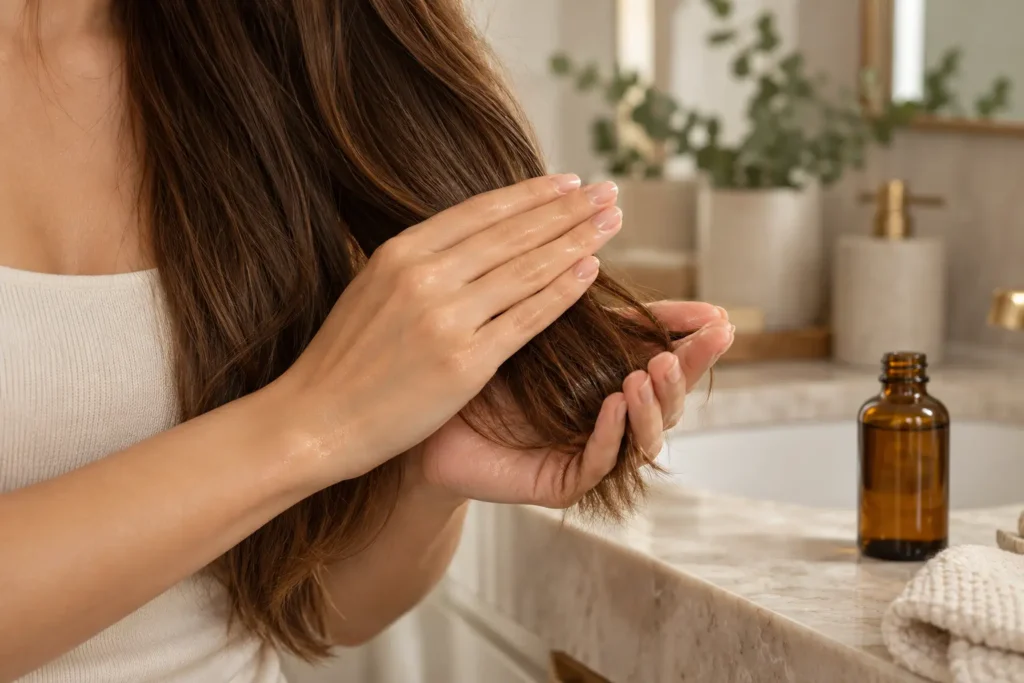
A pre-shampoo treatment lets you try a richer application without wearing the residue all day. A finishing application should use much less, often a drop spread between your palms before touching the ends.
Keep conditioner after shampooing. Oil doesn’t replace every function of a formulated conditioner or detangler. The American Academy of Dermatology recommends conditioning and gentle grooming to reduce damage, and advises against hot-oil treatments for fragile, thinning hair.
For a new product that will contact your scalp, test it on a small skin area first. AAD guidance recommends twice-daily testing for seven to 10 days, respecting the product’s intended contact time. This can help identify reactions, though it cannot guarantee future tolerance.
Persistent itching, burning, or a rash is a reason to stop using the product.