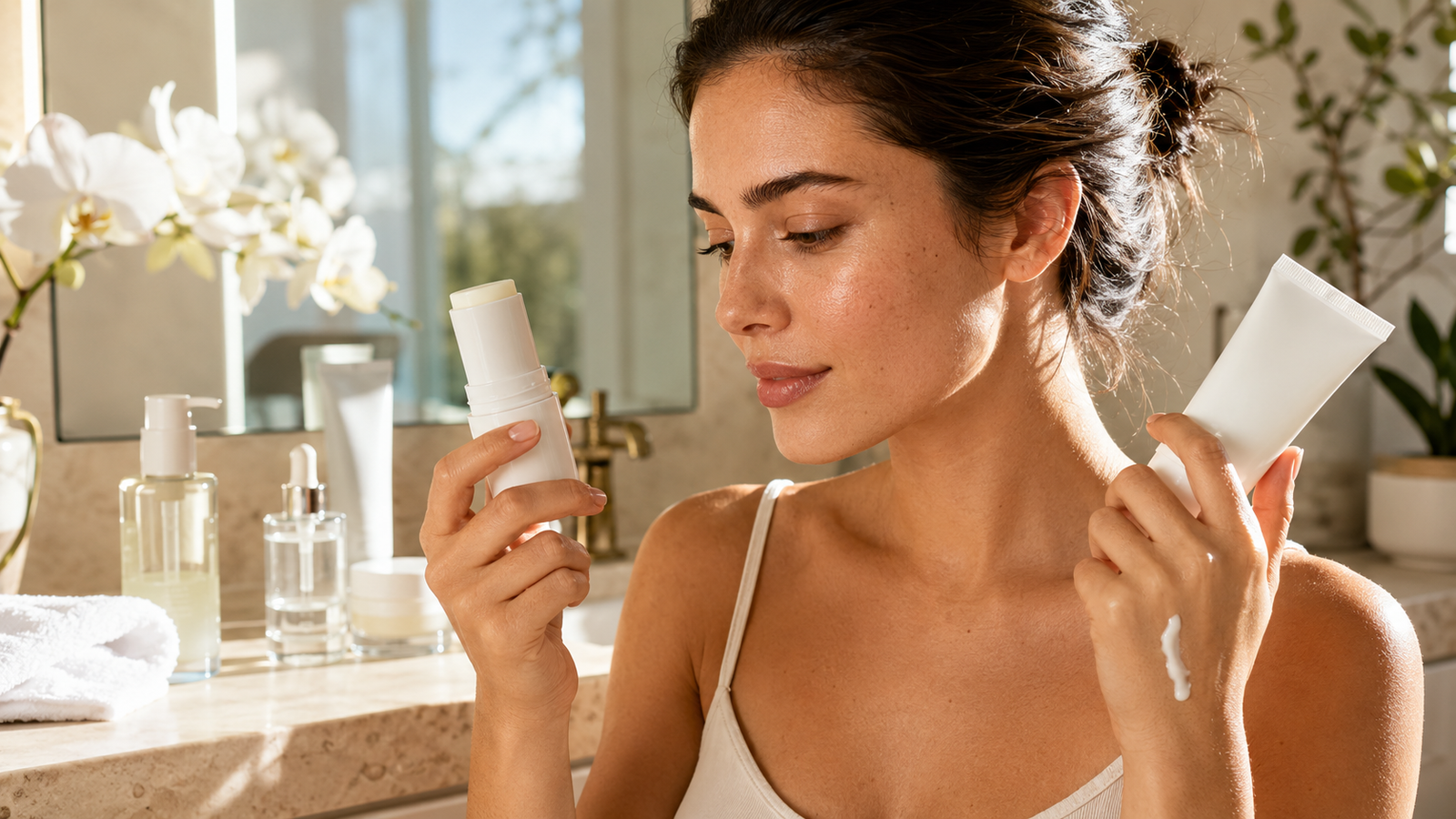
A sunscreen stick feels incredibly convenient. You can swipe it on in seconds, toss it into your bag, and reapply without getting lotion all over your hands. That’s exactly why they’ve become so popular. But convenience raises an important question: does a sunscreen stick actually protect as well as a traditional lotion?
The honest answer is a little more nuanced than social media makes it sound. If you apply both exactly as they’re tested in a laboratory, a sunscreen stick and a sunscreen lotion can provide the same SPF protection. In everyday life, though, most people don’t apply enough sunscreen—especially with sticks. That’s why lotion usually delivers more reliable protection, even when both products have the same SPF on the label.
If you’re trying to decide between a sunscreen stick and a lotion, this guide breaks down what really matters, including application, coverage, skin type, reapplication, outdoor use, and why your technique has a bigger impact than the format itself.
Quick Answer: Sunscreen Stick vs Lotion Which Protects Better?
For most people, sunscreen lotion protects better because it’s easier to apply an even, generous layer that matches the SPF tested in the lab. A sunscreen stick can offer the same protection, but only if you make several slow, overlapping passes across every area of skin. Lotion is usually the best choice for your first morning application, while sticks are excellent for convenient reapplication throughout the day.
| Factor | Sunscreen Stick | Sunscreen Lotion |
|---|---|---|
| Overall UV protection | Excellent when applied generously | Excellent and easier to achieve |
| Morning application | Good | Best choice |
| Reapplication | Excellent | Very good |
| Face coverage | Very good | Excellent |
| Body coverage | Slower | Fast and efficient |
| Over makeup | Excellent | Can disturb makeup |
| Around the eyes | Easier to control | May migrate into eyes |
| Travel convenience | Excellent | Good |
| Cost per application | Usually higher | Usually lower |
| Best for | Touch-ups and portability | Daily full-face and body protection |
Why Sunscreen Lotion Usually Protects Better in Real Life
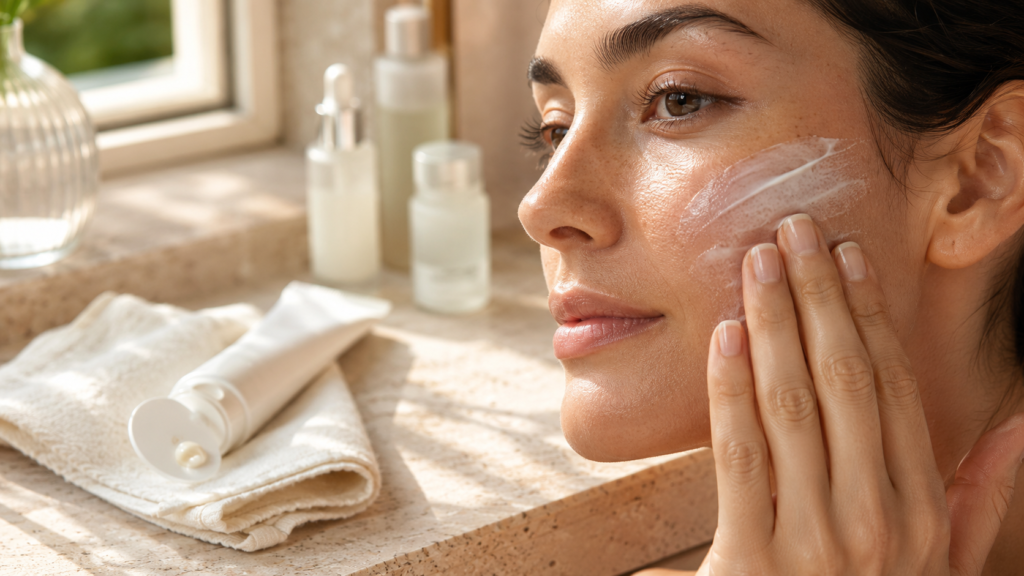
This isn’t because lotion contains stronger UV filters. The difference comes down to how sunscreen is tested and how people actually use it.
When a sunscreen earns an SPF rating, it’s tested using a specific amount of product spread evenly across the skin. That amount is much more generous than most people naturally apply. Research consistently suggests that everyday users often apply far less sunscreen than they should, which means the protection they receive can be lower than the number printed on the bottle.
Lotion makes reaching that recommended amount much easier. You can see where you’ve applied it, spread it evenly, and immediately notice any missed spots. A stick doesn’t spread itself the same way. If you swipe it once or twice and move on, you’re probably leaving behind a much thinner layer than intended.
I’ve caught myself doing exactly that. For a while, I assumed two quick swipes with a sunscreen stick were enough because my skin felt coated. After paying closer attention, it became obvious that several areas barely had any product at all. Once I started making multiple slow passes, the stick lasted less time—but my coverage improved dramatically.
That’s why the question isn’t really whether sticks or lotions contain better sunscreen. It’s whether you’ll apply enough of either one to reach the protection promised on the label.
SPF Numbers Don’t Change—Your Application Does
One of the biggest misconceptions is that a sunscreen stick automatically provides less SPF than a lotion with the same number on the label.
That’s not true.
If both products are broad-spectrum SPF 50 and both are applied in the correct amount, they should provide very similar protection against UVB rays while also helping defend against UVA damage.
Where things change is the thickness of the sunscreen layer.
Imagine painting a wall. A single thin coat leaves uneven coverage, while a second coat fills in the gaps. Sunscreen works in a surprisingly similar way. Thin, patchy application creates tiny areas where UV rays can reach the skin more easily.
With lotion, it’s relatively simple to build that protective layer because the product spreads naturally. A sunscreen stick requires repeated overlapping strokes to achieve something similar.
This is one reason many people believe their sunscreen “doesn’t work.” Often, the product isn’t failing—the application is.
Good to Know: If a sunscreen stick glides over your face in less than ten seconds, there’s a good chance you haven’t applied enough product. Slow, overlapping passes are much more effective than quick swipes.
The Biggest Mistake People Make With Sunscreen Sticks
The most common mistake isn’t choosing a stick instead of a lotion.
It’s assuming one pass equals one application.
Because sticks feel waxy and leave an immediate layer on the skin, it’s easy to think you’ve used plenty. In reality, that first swipe often transfers much less sunscreen than you expect.
For dependable protection, treat each section of your face separately. Cover your forehead, cheeks, nose, chin, jawline, and neck with multiple overlapping passes before lightly blending with clean fingertips if needed. This helps fill tiny gaps without rubbing away the sunscreen you’ve just applied.
Pay extra attention to areas people regularly miss, including:
- The sides of the nose
- Around the nostrils
- The hairline
- The temples
- The tops of the ears
- Under the jaw
- The back of the neck if it’s exposed
These small areas account for a surprising number of sunburns because they’re easy to overlook during a rushed morning routine.
Why Coverage Matters More Than SPF 30 vs SPF 50
Many people spend a long time deciding between SPF 30 and SPF 50 while paying very little attention to how they’re applying it.
That’s backwards.
A well-applied SPF 30 often performs better than a carelessly applied SPF 50. If half the recommended amount reaches your skin, you won’t receive the full protection shown on the label regardless of whether you’re using a stick or a lotion.
That doesn’t mean SPF numbers don’t matter. Higher SPF provides a greater margin of protection, especially if your application isn’t perfect. But no sunscreen can compensate for large missed areas or an extremely thin layer.
Think of SPF as the potential protection. Your application determines how much of that potential you actually receive.
Face vs Body: The Better Choice Changes
One reason this comparison confuses people is that the best sunscreen format isn’t always the same for every part of your body.
Why Sunscreen Lotion Wins for Large Areas
If you’re applying sunscreen to your arms, shoulders, chest, legs, or back before spending the afternoon outside, lotion is simply more practical.
Large areas require a generous amount of product. Lotion spreads quickly, covers skin evenly, and takes much less time than repeatedly swiping a sunscreen stick over your entire body.
There’s another advantage people don’t always think about: cost.
Because body application requires so much sunscreen, a stick can disappear surprisingly fast. If you’re using it for full-body coverage every weekend, you’ll probably replace it much sooner than a bottle of lotion.
For that reason alone, lotion is usually the smarter everyday choice for beaches, hikes, pool days, and outdoor sports.
Why Sunscreen Sticks Excel on the Face
The face is different.
It has smaller, more detailed areas around the eyes, nose, lips, and hairline where precision matters.
A sunscreen stick makes those areas easier to cover without sunscreen running into your eyes or dripping onto your clothes. That’s one reason many people eventually settle on a combination approach: lotion for the body and morning face application, then a stick for touch-ups throughout the day.
Why Sunscreen Sticks Are the Best Tool for Reapplication
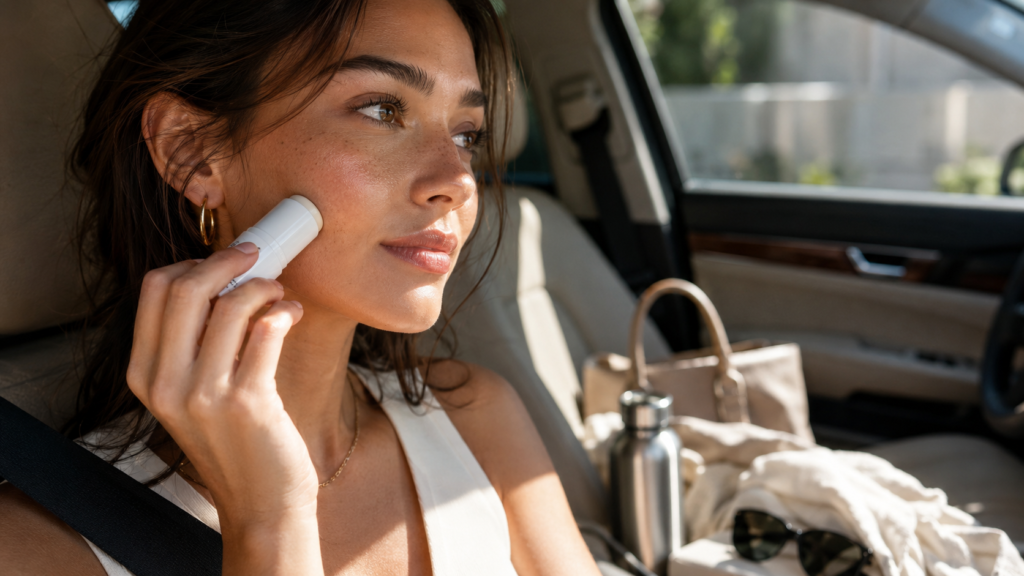
If there’s one area where sunscreen sticks consistently outperform lotions, it’s reapplication.
Almost everyone starts the day with good intentions. You apply sunscreen before leaving home, then hours pass, you’re outside, your hands aren’t clean, you’re wearing makeup, or you’re sitting in the car between errands. That’s when reapplication becomes inconvenient, and inconvenient routines usually get skipped.
A sunscreen stick removes many of those barriers. It doesn’t spill in your bag, you don’t need to squeeze product into your hands, and you can quickly cover exposed areas without feeling like you’re starting your skincare routine all over again.
That’s a practical advantage that often matters more than laboratory comparisons. A sunscreen you actually reapply will usually protect your skin better than a lotion sitting untouched at the bottom of your beach bag.
Reapplying Over Makeup
This is where sunscreen sticks make the strongest case for themselves.
Traditional lotions can smear foundation, move concealer, or leave streaks that require fixing afterward. A stick lets you refresh your SPF with much less disruption.
That doesn’t mean you should drag the stick aggressively across your face. Instead, use light pressure and short strokes. If needed, gently press the sunscreen into your skin with a clean makeup sponge rather than rubbing it around with your fingers.
This technique helps preserve your makeup while improving coverage.
Pro Tip: If your skin is very oily by midday, blot excess oil before reapplying sunscreen. The stick will glide more evenly and adhere better instead of sliding over a shiny surface.
Sweat, Swimming, and Sports: Which One Holds Up Better?
This is another question that doesn’t have a simple winner.
Both sunscreen sticks and lotions are available in water-resistant formulas, and both can perform well during outdoor activities. The important detail is that water-resistant doesn’t mean waterproof.
Sunlight isn’t the only thing wearing away your sunscreen.
Throughout the day, protection gradually decreases because of:
- Sweat
- Swimming
- Towel drying
- Rubbing your face
- Clothing friction
- Touching your skin
- Natural oil production
None of these affect only lotions or only sticks. Every sunscreen needs reapplication after extended outdoor exposure.
Where sticks have an advantage is convenience. If you’re hiking, golfing, cycling, or spending the afternoon at a theme park, it’s much easier to carry a stick in your pocket than a bottle of lotion.
For long beach days or outdoor sports, though, many people find the best routine is using lotion before heading outside and carrying a stick for quick touch-ups on the face, ears, and neck.
Does Skin Type Change Which Format Is Better?
Skin type doesn’t automatically determine whether you should choose a stick or a lotion, but it can influence which texture feels comfortable enough to wear every day.
Oily Skin
People with oily skin often assume sunscreen lotion will feel heavy.
That’s sometimes true, but not always. Plenty of lightweight lotions absorb quickly without leaving a greasy finish.
Sunscreen sticks can also work well for oily skin, especially if they’re marketed as lightweight or non-comedogenic. Just remember that some stick formulas contain richer waxes and emollients that create a noticeable sheen.
Texture matters more than format.
Dry Skin
Dry skin usually benefits from lotion because many formulas include moisturizing ingredients that help reduce water loss throughout the day.
Look for labels mentioning ingredients such as:
- Ceramides
- Glycerin
- Hyaluronic acid
- Squalane
These ingredients don’t replace your moisturizer, but they can make sunscreen feel much more comfortable.
If you prefer using a stick, apply moisturizer first and let it absorb before applying sunscreen. The stick will glide more smoothly and is less likely to catch on dry patches.
Combination Skin
Combination skin is often the easiest to customize.
Some people use lotion across the entire face. Others apply lotion first thing in the morning and keep a sunscreen stick nearby for touching up oily areas like the forehead and nose later in the day.
There’s no rule saying you have to commit to only one format.
Sensitive Skin
Sensitive skin is less about whether a sunscreen comes in stick or lotion form and more about what’s inside it.
Look for products that are:
- Fragrance-free
- Broad-spectrum
- Suitable for sensitive skin
- Free from unnecessary essential oils if those usually bother your skin
Whenever you’re trying a new sunscreen, patch test it on a small area for a couple of days before using it across your entire face.
Mineral vs Chemical Sunscreen: Does the Format Matter?
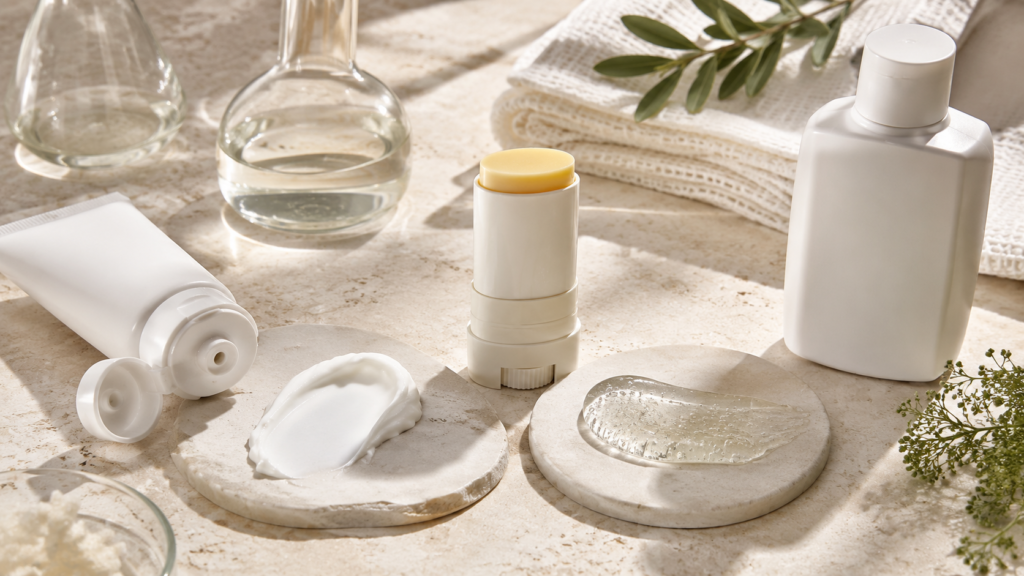
Many people accidentally compare two different things.
A sunscreen stick can be mineral or chemical. A sunscreen lotion can also be mineral or chemical. The delivery format doesn’t automatically tell you which UV filters it contains.
Mineral sunscreens use ingredients that sit on the skin’s surface and reflect or scatter a portion of UV radiation while also absorbing some UV energy. They’re often chosen by people with sensitive skin, although some formulas can leave a noticeable white cast depending on your skin tone.
Chemical sunscreens absorb UV energy before it can damage the skin. Modern formulas are often lightweight and nearly invisible, making them popular for everyday wear.
Neither technology automatically protects better simply because it’s in a stick or a lotion.
The more important questions are:
- Is it broad-spectrum?
- Will you apply enough?
- Will you reapply it every two hours during continued sun exposure?
Those three factors influence real-world protection far more than the product’s texture.
Can You Use Both Together?
Absolutely—and for many people, this ends up being the most practical routine.
Think of lotion and sticks as serving different purposes rather than competing against each other.
Apply a generous layer of sunscreen lotion as the final step of your morning skincare routine before makeup. This gives you the strongest foundation for the day because it’s easier to achieve even coverage across your face, neck, and any exposed skin.
Then carry a sunscreen stick for reapplication. It’s faster, cleaner, and much more realistic to use when you’re commuting, walking outside during lunch, sitting at a sporting event, or traveling.
After testing both formats in different situations, this combination is the one I keep coming back to. It requires less effort than trying to make one product handle every situation, and because it’s easier to stick with, you’re more likely to stay protected consistently.
Indoor Use: Do You Need a Stick or Lotion if You’re Mostly Inside?
This question comes up surprisingly often, and the answer depends on how you spend your day.
If you’re indoors all day with the curtains closed and you’re rarely near windows, your UV exposure is much lower than someone commuting, walking outside at lunch, or working beside a large sunny window. But “indoors” doesn’t always mean “away from the sun.”
UVA rays, which contribute to premature skin aging and pigmentation, can pass through standard window glass. If your desk sits beside a bright window for several hours a day or you drive frequently, daily sunscreen is still a smart habit.
In those situations, the format matters less than consistency. A lotion is usually the better morning application because it creates a more even protective layer, while a stick makes quick reapplication easy if you’re heading outside later.
The Cost Difference Most People Don’t Think About
Price tags don’t tell the whole story.
A sunscreen stick often looks reasonably priced until you consider how much product you’re supposed to apply. Because multiple passes are needed to achieve the labeled SPF, a stick can run out much faster than many people expect.
Lotion, on the other hand, spreads more easily over larger areas, so one bottle typically lasts longer when used correctly.
That doesn’t make sticks poor value. They’re solving a different problem. You’re paying for convenience, portability, and easy touch-ups rather than economical full-body coverage.
If sunscreen sticks seem expensive, it’s often because people are finally applying enough product—which is exactly what they should be doing.
Common Mistakes That Reduce Protection
People often blame a sunscreen when the real problem is how it’s being used.
These are the mistakes I see most often:
- Applying sunscreen only once in the morning and never reapplying.
- Using only one or two quick swipes with a sunscreen stick.
- Forgetting the ears, hairline, neck, and tops of the hands.
- Applying sunscreen immediately before going outside instead of giving it time to form an even film.
- Assuming makeup with SPF replaces a dedicated sunscreen.
- Saving sunscreen only for beach days instead of wearing it during everyday outdoor exposure.
Small habits like these have a much bigger impact than switching between sticks and lotions.
Watch Out: Sunscreen should be the final step of your morning skincare routine before makeup. Applying skincare products over sunscreen afterward can disturb the protective layer and reduce even coverage.
How to Get the Best Protection From Either Format
The format you choose matters, but your routine matters even more.
For sunscreen lotion:
- Apply it generously as the final skincare step before makeup.
- Cover your face, ears, neck, and any exposed skin evenly.
- Allow it to settle before applying foundation or other makeup products.
- Reapply every two hours during continued sun exposure.
For sunscreen sticks:
- Apply slow, overlapping passes over every section of skin.
- Don’t forget small areas like the nose, temples, ears, and hairline.
- Lightly blend if needed to improve even coverage.
- Reapply frequently, especially after sweating, swimming, or towel drying.
Neither product needs to be perfect. The goal is building a routine you’ll actually follow every day.
Which One Is Right for You?
Choose sunscreen lotion if you:
- Want the most reliable everyday protection.
- Need to cover your face and body quickly.
- Spend long periods outdoors.
- Have dry or dehydrated skin.
- Prefer getting your full sunscreen application done at home.
Choose a sunscreen stick if you:
- Need easy reapplication during the day.
- Wear makeup regularly.
- Travel often.
- Want precise application around the eyes and nose.
- Like carrying sunscreen in your pocket or handbag.
If you’re still undecided, you don’t have to pick just one.
For most people, the most effective routine is using lotion in the morning and keeping a sunscreen stick nearby for touch-ups. It combines the strengths of both formats without asking either one to do everything.
So, Which Protects Better?
Here’s the honest conclusion after comparing both formats from every practical angle.
If a sunscreen stick and a sunscreen lotion have the same SPF, are broad-spectrum, and are applied in exactly the same amount, their protection is essentially the same.
The reason lotion usually comes out ahead is much simpler than the ingredients.
Most people naturally apply enough lotion to get close to the advertised SPF. With sticks, many people use too little product, make only one or two quick passes, and unknowingly reduce their protection.
That doesn’t mean sunscreen sticks are inferior. In fact, they’re one of the easiest ways to stay consistent with reapplication, and consistency is what keeps sunscreen working throughout the day.
The best sunscreen isn’t automatically a stick or a lotion.
It’s the one you’ll apply generously, reapply regularly, and wear every single day.