
Your hair feels soft after conditioning, but the ends turn rough again once it dries. Detangling takes longer than it should, and adding more oil leaves you with greasy strands that still don’t feel manageable.
That pattern can happen with porous, weathered hair. But dryness alone doesn’t tell you your porosity, and buying every product labeled “repair” can make your routine more confusing.
Effective high porosity hair care focuses on making strands easier to handle while limiting further damage. Consistent conditioning matters, but so do the way you wash, detangle, dry, and style your hair.
You don’t need to achieve a perfect porosity label before improving your routine. Start with what your hair needs: less friction, suitable conditioning, and fewer habits that leave it brittle.
What High Porosity Means for Your Hair
Hair porosity describes aspects of the spaces within a hair fiber and how substances can move through it. In everyday hair care, the term usually refers to hair that takes up water readily because its protective structure is more disrupted.
The cuticle—the outer layer of overlapping cells—helps protect the inside of the strand. Chemical processing and weathering can affect that protection. Laboratory research has measured changes in hair’s pore structure after bleaching, confirming that porosity is more than a social-media category.
However, dividing every head of hair neatly into “low,” “medium,” or “high” porosity simplifies a more complicated situation.
Your older ends may behave differently from newer growth. Highlighted sections may need more conditioning than untreated sections. Fine, straight hair and thick curls can both experience damage while needing very different product textures.
Porosity is one consideration, not a complete hair-care prescription.
Signs Worth Paying Attention To
Look for patterns rather than one isolated symptom:
- Your processed ends feel rougher than your roots.
- Strands catch on each other during detangling.
- You notice short broken pieces or splitting ends.
- Hair becomes difficult to manage after repeated coloring or heat styling.
- Conditioner improves the feel, but your current routine still leaves the lengths uncomfortable.
These observations can help you identify care needs. They don’t independently prove high porosity.
Can the Float Test Confirm Hair Porosity?
Don’t treat a strand floating or sinking in water as a definitive result.
Published porosity research uses controlled methods, including gas sorption and measurements of water confined within hair pores. A glass-of-water test doesn’t provide the same information. Drying speed also varies with hair thickness, density, styling products, and conditions around you.
For a practical routine, your treatment history and response to products are more useful starting points than repeatedly testing a strand.
Build a High Porosity Hair Care Routine
Begin with cleansing, rinse-out conditioner, and careful handling. Add other products only when those basics leave a specific problem unresolved.
Clean Your Scalp Without Scrubbing the Ends
Dry lengths don’t mean your scalp should go unwashed.
Choose wash frequency according to oil, sweat, buildup, and scalp comfort. Apply shampoo mainly to the scalp rather than vigorously working it through the entire length. The American Academy of Dermatology recommends this approach to cleanse while avoiding unnecessary drying of the hair.
Use your fingertips to distribute the shampoo and keep the lengths from becoming a tangled pile on top of your head.
If you use several styling products and your hair begins to feel coated, assess whether your usual shampoo cleans adequately. A clarifying wash may be useful when needed, but there’s no universal schedule that every person with porous hair should follow.
Likewise, a “sulfate-free” label alone doesn’t tell you whether a shampoo will suit you. Judge the complete formula by how comfortably it cleans your scalp and how your hair feels afterward.
Condition the Areas That Need It
Conditioner should be a regular part of washing, especially when the lengths are dry or difficult to detangle.
For fine or straight hair, concentrate on the ends. Dry, curly hair may benefit from conditioning more of the length. These adjustments reflect the AAD’s guidance to match conditioner placement to hair type.
Spread it evenly rather than placing a large amount on one section. Follow the label’s contact time, and notice whether the product provides enough slip to loosen tangles comfortably.
More product isn’t automatically better. If your roots look flat while the ends remain rough, change where you apply it before replacing the whole routine.
Add Leave-In Conditioner When Necessary
A leave-in can be useful when rinse-out conditioner alone doesn’t keep hair manageable. The AAD identifies dry, curly, long, chemically treated, and heat-styled hair among the types that may benefit.
Start with a small amount on damp mid-lengths and ends. Choose a light spray or lotion for fine hair and consider a cream if thicker strands need more conditioning.
The goal is easier handling. Hair shouldn’t need to feel heavily coated for the product to be useful.
Use a formula intended to stay in the hair. Don’t assume a rinse-out conditioner can safely become a leave-in simply by diluting it with water.
Use a Mask for a Specific Need
A deep conditioner or hair mask is optional. Consider one if your regular conditioner doesn’t provide enough softness or slip.
Try replacing your usual conditioner with the mask for one wash, following its instructions. Then compare the result. Was detangling easier? Did the ends remain comfortable? Did the hair feel heavy?
You don’t need a mask, rinse-out conditioner, protein treatment, and rich leave-in at every wash. That makes it difficult to know which product is helping.
Overnight use also isn’t automatically more effective. Leave a treatment on overnight only if it’s formulated and directed for that purpose.
Choose Ingredients by What They Do
A useful product label explains more than “for high porosity hair.” Look at the formula’s role and texture.
| Ingredient category | Examples on labels | Why you might choose it |
|---|---|---|
| Conditioning agents | Behentrimonium chloride, cetrimonium chloride | Improve slip and manageability |
| Fatty alcohols | Cetyl alcohol, cetearyl alcohol | Add body and softness to conditioning formulas |
| Silicones | Dimethicone, amodimethicone | Help lubricate strands and smooth their feel |
| Hydrolyzed proteins | Hydrolyzed keratin, wheat or rice protein | Provide formulation-dependent conditioning or strengthening effects |
| Oils and emollients | Coconut oil, argan oil, shea butter | Add lubrication or a richer finish |
These ingredients serve different functions. Cosmetic reviews describe how conditioning agents, silicones, oils, and protein-derived ingredients can improve hair handling and surface properties. Their effectiveness depends on the complete formula. PMC
Fatty alcohols such as cetyl alcohol aren’t the same as the quick-evaporating alcohol found in some styling formulas. Their presence in a conditioner isn’t a reason to reject it.
Similarly, silicones don’t need to be excluded simply because your hair is porous. Assess whether a formula improves slip without leaving an unwanted coated feel.
Does High Porosity Hair Need Protein?
It may benefit from a protein-containing product, but the porosity label doesn’t establish a required treatment schedule.
Hydrolyzed proteins are broken into smaller components for cosmetic use. Some protein-derived ingredients can temporarily improve hair’s strength or surface properties; that isn’t equivalent to growing a new, undamaged strand.
If you want to try one, introduce a single product and follow its directions. Avoid adding several strengthening treatments at once.
Assess the result after washing and drying. If hair feels more manageable, the formula may suit you. If it becomes unpleasantly stiff, tangled, or coated, reduce use or choose something else.
Those sensations don’t confirm an online diagnosis of “protein overload.” They tell you that the product or routine needs adjusting.
Use Oil as a Finishing Step
Oil can make rough ends feel smoother, but pouring on more isn’t a substitute for conditioning.
If your hair still feels frizzy after leave-in conditioner, the AAD suggests that a small amount of oil, such as argan oil, may help.
Begin with a tiny amount worked between your palms, then touch it onto the areas that need it. Fine strands usually need a lighter application than thick hair.
If the result feels greasy without improving manageability, stop adding layers. Reassess your conditioner, cleansing, and damage exposure instead.
There’s no requirement to follow a fixed liquid-oil-cream sequence. Use the fewest steps that produce a comfortable result.
Protect Hair While Detangling and Styling
A good conditioner can’t compensate for repeatedly pulling through knots or applying excessive heat.
Detangle According to Your Texture
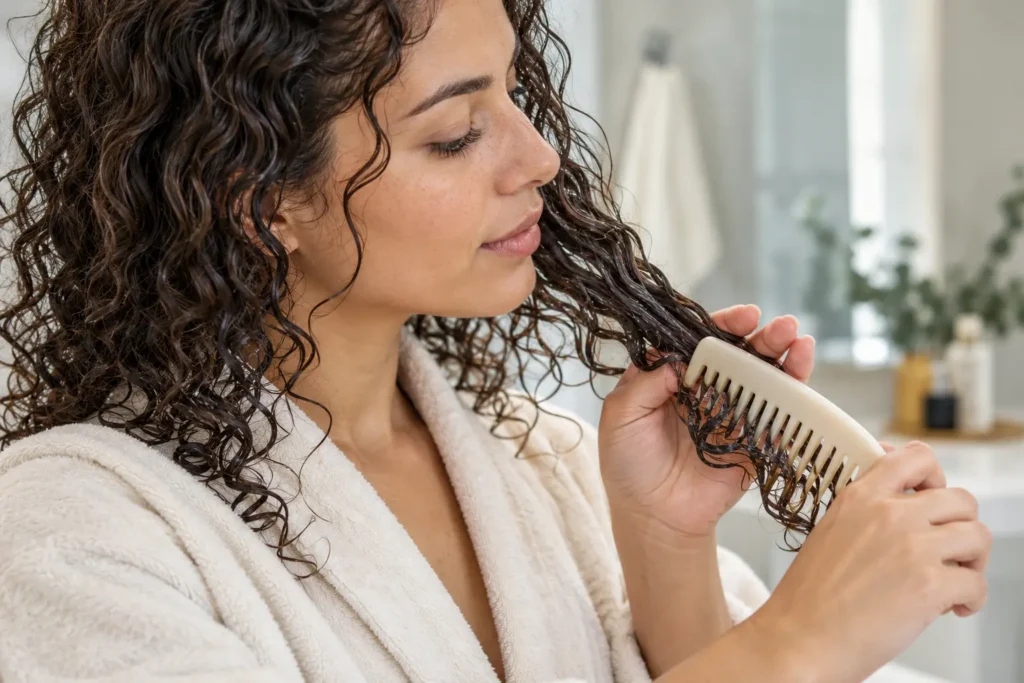
For thick curls, detangling with conditioner in the shower can be helpful. For straight hair, allow it to dry somewhat before gently combing. Work from the ends upward with a wide-tooth comb rather than dragging through the full length.
Separate a difficult knot with your fingers first. Pause when you meet resistance.
Sectioning can make the task more manageable, particularly when you have dense hair. You’re aiming to untangle the strands with less force, not finish as quickly as possible.
Reduce Heat and Repeated Passes
Use hot tools less frequently and keep settings low enough to achieve your style without repeatedly reheating the same area. Flat irons should be used on dry hair.
Choose a product specifically labeled for heat protection; an ordinary oil or leave-in doesn’t automatically perform that function.
Plan styles that last comfortably between washes so you’re less tempted to straighten or curl the ends every morning.
Keep Styles Comfortable
Repeatedly tight ponytails, braids, and extensions can create damaging tension. Looser styling matters if you’re trying to reduce breakage.
A style shouldn’t hurt or pull at the hairline. Change how you secure it if it does.
Give Processed Ends Extra Attention
If your roots are manageable but your highlighted ends snag, treat those sections differently.
Use lighter products near the roots and concentrate richer conditioning where you need it. Before another chemical service, tell your stylist where you’re noticing breakage and discuss whether the existing lengths can tolerate further processing.
Research shows that bleaching can increase vulnerability to damage from subsequent treatments. A conditioning routine doesn’t make repeated chemical processing risk-free.
For swimming, consider a cap and rinse promptly afterward. The AAD recommends appropriate cleansing followed by deep conditioning after pool exposure. A hat also provides useful protection during prolonged sun exposure.
How to Tell Whether Your Routine Is Working
Judge high porosity hair care by manageable improvements:
- Fewer snags during detangling.
- Ends that feel smoother between washes.
- Less need to reapply several products.
- Fewer broken pieces during styling.
- A comfortable scalp alongside conditioned lengths.
A leave-in may improve feel immediately, but assessing breakage requires observing several washes and styling sessions.
Change one element at a time. Keep a brief note of what you used and how your hair behaved after drying.
Existing hair doesn’t heal like living skin. Cosmetic care can improve its properties and reduce further wear, but severely damaged sections may still need trimming. Persistent breakage, sudden thinning, bald patches, or scalp inflammation warrant professional assessment.