
Overnight hair oiling has been passed down through generations, but it’s also one of the most misunderstood hair care routines. Some people wake up with softer, shinier hair after using a Coconut Oil Hair Mask Overnight Deep Condition, while others are left with greasy strands that feel heavy and difficult to wash. The difference usually isn’t the coconut oil itself. It comes down to your hair type, how you apply it, and whether your hair actually benefits from an overnight treatment.
Coconut oil isn’t just another plant oil that sits on the surface of your hair. It’s one of the few natural oils that can penetrate the hair shaft, which is why it has remained a staple in hair care long after countless beauty trends have come and gone. Used correctly, it can help reduce protein loss, improve softness, and make dry or damaged hair easier to manage. Used incorrectly, it can leave healthy hair feeling coated instead of conditioned.
If you’re wondering whether sleeping in coconut oil is really worth it, this guide breaks down what actually works, who should try it, and how to get the benefits without making common mistakes.
Quick Answer
A Coconut Oil Hair Mask Overnight Deep Condition can improve softness, reduce protein loss, and help protect dry or damaged hair from everyday wear. It’s most beneficial for coarse, curly, high-porosity, color-treated, or heat-damaged hair. If your hair is naturally fine or low porosity, leaving coconut oil on overnight usually offers little extra benefit compared to a one- to three-hour treatment and may simply lead to more buildup.
Why Coconut Oil Works Differently Than Most Hair Oils
Hair oils are often treated as if they all perform the same job, but they don’t. Many plant oils mainly coat the outside of the hair, creating temporary shine and helping reduce friction while brushing. Once you shampoo, much of that surface layer washes away, leaving little behind.
Coconut oil behaves differently because it’s naturally rich in lauric acid, a medium-chain fatty acid with a relatively small molecular structure. That structure allows part of the oil to move through the cuticle and into the hair shaft instead of remaining only on the surface. This is one of the main reasons coconut oil has been studied more than many other natural oils for hair care.
That difference becomes important when you understand what everyday damage actually does to your hair. Hair is made mostly of keratin proteins, and every wash, blow-dry, bleach session, or flat iron slowly weakens that structure. Research generally suggests coconut oil can help reduce protein loss during washing, which may leave hair feeling stronger and less prone to breakage over time.
One misconception that’s worth clearing up is that coconut oil “hydrates” your hair. It doesn’t. Water is what hydrates hair, while coconut oil helps reduce moisture loss after water is already inside the strand. In other words, it works more like a protective seal than a source of hydration itself.
Why Overnight Treatments Sometimes Work Better
Leaving coconut oil on overnight gives it more time to interact with damaged areas of the hair shaft. Hair that’s dry, chemically processed, or naturally porous often has lifted cuticles, making it easier for the oil to penetrate. That’s why people with damaged hair usually notice softer, smoother strands after an overnight treatment.
Healthy hair doesn’t always respond the same way. If your cuticle is already compact and smooth, your hair can only absorb a limited amount of oil. Leaving coconut oil on for eight hours instead of two doesn’t necessarily improve the result—it often just leaves more residue to wash away in the morning.
This explains why one person may swear by overnight coconut oiling while another says it made their hair greasy. Both experiences can be completely accurate because hair structure varies from person to person.
Good to Know: Coconut oil works best as a pre-shampoo treatment, not a replacement for conditioner. Shampoo removes the excess oil sitting on the surface while leaving behind the portion that has already penetrated the hair shaft.
Who Benefits Most From a Coconut Oil Hair Mask Overnight Deep Condition?

One of the biggest mistakes people make is assuming every hair type needs the same routine. In reality, overnight oiling works best when it’s matched to your hair’s texture, porosity, and level of damage.
Dry or Heat-Damaged Hair
Hair that’s regularly exposed to curling irons, straighteners, or frequent blow-drying tends to lose moisture more quickly because repeated heat gradually roughens the outer cuticle. Once that protective layer becomes uneven, water escapes more easily and the hair begins to feel rough or brittle.
An overnight coconut oil treatment won’t reverse heat damage, but it can help reduce further stress during washing and brushing. Over time, many people notice that their hair tangles less easily and feels smoother after styling because the cuticle experiences less friction.
Bleached or Color-Treated Hair
Chemical treatments intentionally lift the cuticle so color molecules can enter the hair. Even when coloring is done professionally, that process leaves the hair more porous than before.
This is where realistic expectations matter. Coconut oil can’t repair bleach damage or permanently rebuild broken hair fibers. What it can do is help reduce ongoing protein loss and improve how damaged hair feels between salon visits. In my experience, people expecting softer, more manageable hair are usually pleased with the results, while those expecting complete repair after one treatment are often disappointed.
Curly and Coily Hair
Natural curls rarely receive enough oil from the scalp because every twist and bend slows the movement of sebum along the hair shaft. That’s one reason curly hair often feels dry even when the scalp itself isn’t.
A Coconut Oil Hair Mask Overnight Deep Condition can help reduce friction between strands, making curls easier to detangle and less likely to snap during wash day. It may also help improve shine and reduce the appearance of frizz, although it won’t permanently change your curl pattern.
High-Porosity Hair
High-porosity hair absorbs water quickly, but it also loses that moisture faster than healthy hair. If your hair dries unusually fast after washing, becomes frizzy in humid weather, or always seems thirsty no matter how much conditioner you use, higher porosity could be the reason.
Because the cuticle is naturally more open, coconut oil often penetrates these strands more effectively than it does healthy, low-porosity hair. That’s why overnight treatments tend to produce the most noticeable improvements on hair that’s already dry or damaged.
Who Should Skip Overnight Coconut Oil Treatments?
Despite its reputation, coconut oil isn’t the best choice for everyone. Some hair types simply respond better to shorter treatments or lighter oils.
Fine Hair
Fine hair has less structural thickness, so it becomes weighed down much more easily than coarse hair. Even a small amount of coconut oil can leave it looking flat if it’s left on overnight.
If your hair struggles to hold volume, start with a one-hour treatment instead. Many people with fine hair discover they get the conditioning benefits they want without waking up with greasy roots.
Low-Porosity Hair
Low-porosity hair has tightly packed cuticles that naturally resist absorbing both water and oils. If conditioners tend to sit on top of your hair instead of soaking in, coconut oil may behave the same way.
Rather than sleeping in it overnight, try using coconut oil as a one- to two-hour pre-shampoo treatment. You’ll often get similar results without dealing with stubborn buildup the next morning.
Naturally Oily Scalp
An oily scalp usually doesn’t need extra overnight oil. Applying large amounts directly to the roots can trap sweat, dead skin, and styling residue, making your hair feel heavier after washing instead of fresher.
Instead, concentrate the oil on your mid-lengths and ends, where dryness is far more common.
Pro Tip: If you’ve never used coconut oil overnight before, test it on one small section of your hair first. It’s an easy way to see how your hair responds before committing to a full overnight treatment.
How to Apply a Coconut Oil Hair Mask Overnight Deep Condition Correctly

The amount of coconut oil you use matters far less than how you apply it. A light, even layer almost always delivers better results than coating your hair until it feels soaked.
Step 1: Start With Slightly Damp Hair
Hair doesn’t need to be freshly washed, but it also shouldn’t be covered in several days’ worth of dry shampoo, hairspray, or styling cream. Excess product creates a barrier that makes it harder for coconut oil to spread evenly across the hair shaft.
Slightly damp hair is ideal because it already contains water for the coconut oil to help seal in. Hair that’s dripping wet simply causes the oil to slide off before it has a chance to coat the strands evenly.
Step 2: Warm a Small Amount Between Your Hands
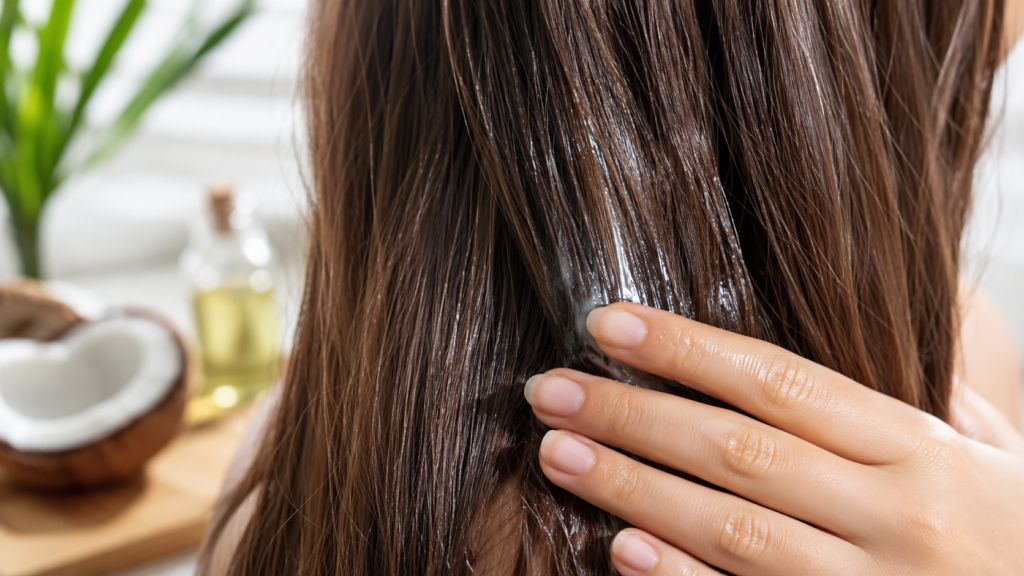
Coconut oil melts naturally with body heat, so there’s no need to overheat it. Rub a small amount between your palms until it becomes liquid before applying it to your hair.
For shoulder-length hair, one to two teaspoons is usually enough. Longer or thicker hair may need slightly more, but resist the temptation to use large handfuls. Once your hair has absorbed what it can, any extra oil simply sits on the surface and becomes harder to wash out the next morning.
Step 3: Apply It Where Your Hair Needs It Most
Start at the mid-lengths and work your way toward the ends. These sections have been exposed to the most washing, brushing, heat styling, and environmental damage, so they benefit the most from deep conditioning. If your hair is especially dry, gently smooth any remaining oil over the outer layer instead of adding more product.
Unless your scalp feels unusually dry, avoid applying a heavy layer directly to the roots. In most cases, concentrating the oil on the lengths gives you the conditioning benefits without leaving your scalp feeling greasy the next morning.
Step 4: Distribute the Oil Evenly
Use a wide-tooth comb or your fingers to spread the oil through each section of hair. Even distribution helps prevent some strands from becoming overloaded while others receive very little product.
Take a minute to check that your ends are lightly coated. They are the oldest part of your hair and usually show the first signs of dryness and split ends, making them the area that benefits most from this treatment.
Step 5: Protect Your Hair While You Sleep
Tie your hair into a loose braid or a loose bun to keep it from tangling overnight. Avoid tight hairstyles because constant tension can contribute to unnecessary breakage, especially around the hairline.
Wearing a satin bonnet or sleeping on a satin pillowcase can also help reduce friction. Cotton pillowcases tend to absorb some of the oil and create more rubbing against the hair cuticle as you move during sleep.
How to Wash Coconut Oil Out Properly
The way you remove coconut oil is just as important as the way you apply it.
Start by thoroughly soaking your hair with warm water. Warm water softens the oil and makes it easier for shampoo to lift it away from the hair shaft. Extremely hot water isn’t necessary and may leave dry hair feeling even drier.
Apply shampoo to your scalp first and massage gently before working the lather through the lengths. If your hair still feels oily after rinsing, shampoo a second time instead of using a large amount of shampoo all at once. Two gentle washes usually clean the hair more effectively than one aggressive wash.
Finish with your regular conditioner, focusing on the mid-lengths and ends. Coconut oil helps reduce moisture loss, but conditioner smooths the cuticle, improves slip, and makes detangling easier. The two products work together rather than replacing one another.
How Often Should You Use a Coconut Oil Hair Mask Overnight Deep Condition?
The ideal schedule depends on your hair rather than a fixed routine.
Very dry, curly, or chemically treated hair often responds well to an overnight treatment once a week. Hair that’s in relatively good condition usually needs it every two weeks, while fine hair may only benefit once every three or four weeks.
Pay attention to how your hair feels after washing. If it starts feeling heavy, limp, or coated, reduce the frequency. If it continues to feel dry and rough despite regular conditioning, your hair may benefit from slightly more frequent treatments.
Common Mistakes That Stop Coconut Oil From Working Well
Using Too Much Oil
One of the biggest misconceptions is that more oil creates deeper conditioning.
Hair can only absorb a limited amount of coconut oil. Once that limit is reached, everything left behind simply coats the surface. Excess oil attracts dirt more easily, feels heavy, and often requires extra shampoo to remove.
Applying It to Dripping Wet Hair
Hair that is soaking wet doesn’t allow coconut oil to spread evenly. Instead of coating the strands, much of the oil slides off along with the excess water.
Slightly damp hair provides a much better balance because the oil can spread evenly while helping slow moisture loss after the treatment.
Replacing Conditioner With Coconut Oil
Coconut oil is not a substitute for conditioner.
Conditioners contain ingredients that smooth the outer cuticle, reduce static, improve manageability, and make hair easier to comb. Coconut oil supports healthy-looking hair, but it doesn’t perform all of those functions on its own.
Expecting Overnight Repair
This is probably the biggest expectation that leads to disappointment.
A Coconut Oil Hair Mask Overnight Deep Condition can leave hair feeling softer after the first treatment, but it won’t permanently repair split ends or reverse bleach damage overnight. Healthier-looking hair comes from reducing future damage over weeks and months rather than expecting one treatment to fix existing damage.
Forgetting to Clarify Occasionally
If you regularly use oils, leave-in products, dry shampoo, or styling creams, residue gradually builds up on the hair.
Using a clarifying shampoo every few weeks helps remove that buildup so conditioners and treatments continue working effectively. Without occasional deep cleansing, even good products can begin sitting on the surface instead of reaching the hair properly.
Can You Leave Coconut Oil on Your Scalp Overnight?
The answer depends on the condition of your scalp.
If your scalp is healthy but occasionally feels dry, a small amount of coconut oil may feel comfortable overnight. Some people also enjoy the gentle scalp massage that comes with applying the oil.
If your scalp is naturally oily or you’re prone to dandruff, itchiness, or scalp breakouts, overnight oiling may make those concerns worse by trapping excess oil and dead skin close to the scalp. In these situations, it’s usually better to apply coconut oil only from the mid-lengths downward.
Persistent redness, severe itching, or unusual hair shedding deserves professional evaluation rather than repeated home treatments.
Can You Mix Coconut Oil With Other Ingredients?
Simple combinations usually work better than complicated recipes.
Aloe vera gel can add lightweight hydration, while a small amount of honey may leave dry hair feeling softer after washing. If pure coconut oil feels too heavy for your hair, adding a few drops of a lighter oil such as jojoba or argan oil can create a thinner consistency that’s easier to spread.
Avoid adding multiple essential oils unless you understand proper dilution. More ingredients don’t automatically create a better treatment, and overly complicated DIY masks are often much harder to rinse away completely.
What Results Can You Honestly Expect?

One treatment is enough for many people to notice softer hair and improved shine. Hair often feels easier to comb after washing because smoother strands create less friction against one another.
With regular use over several weeks, you may notice less breakage while brushing, smoother-looking ends, and hair that feels more manageable between wash days. These improvements happen gradually because you’re helping reduce ongoing damage rather than repairing damage that has already occurred.
It’s equally important to understand what coconut oil cannot do. It won’t permanently repair split ends, reverse chemical damage, dramatically speed up hair growth, or replace regular trims. Those claims are common online, but they aren’t supported by how hair actually grows and behaves.