
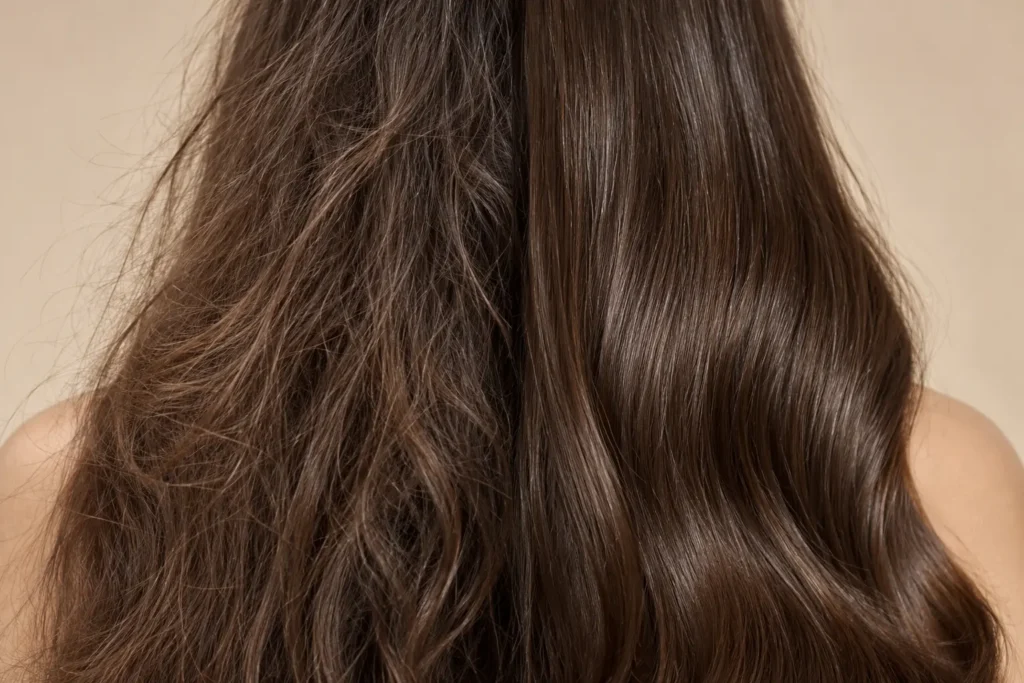
Dry, frizzy hair is not simply a styling problem. It often reflects changes in the hair fiber, including moisture loss, cuticle damage, increased friction, and the effects of humidity. While many hair care products promise instantly smooth, shiny hair, managing frizz effectively requires understanding what causes it and choosing treatments that address those causes.
Hair texture, genetics, chemical treatments, environmental conditions, and daily grooming habits all influence how hair behaves. For example, naturally curly hair tends to experience more dryness because scalp oils do not spread as easily along curved hair fibers. Meanwhile, frequent heat styling, bleaching, and harsh washing can damage the protective outer layer of the hair, making it more vulnerable to tangling and breakage.
The most effective dry frizzy hair care routine is not necessarily the one with the most products. It is a consistent approach built around gentle cleansing, effective conditioning, reduced friction, and protection from avoidable damage.
This guide explains the science behind dry and frizzy hair, the ingredients that actually help, and how to build a practical routine using established dermatological recommendations and hair fiber research.
Understanding Why Hair Becomes Dry and Frizzy
Before choosing products, it is important to understand the difference between dryness and frizz. Although they frequently occur together, they are not identical conditions.
Dry hair generally feels rough, lacks flexibility, tangles easily, and may appear dull. It can result from insufficient lubrication, weathering of the hair fiber, chemical processing, or repeated exposure to harsh cleansing and heat.
Frizzy hair occurs when individual strands fail to align smoothly with surrounding hair. This can happen because of humidity, natural curl patterns, static electricity, uneven cuticle surfaces, or physical damage.
The hair shaft consists of several structural components, but two are particularly important for understanding frizz:
- Cuticle: The outer protective layer, made of overlapping cells that help protect the inner hair structure.
- Cortex: The main structural region, containing keratin proteins that contribute to hair strength, elasticity, and shape.
When the cuticle becomes damaged through friction, chemical treatments, or excessive heat, the hair surface can become rougher. This increases friction between strands and makes tangling, breakage, and frizz more likely.
Humidity introduces another challenge. Hair fibers absorb water from the surrounding air, which can temporarily alter hydrogen bonding within the hair. As different strands respond unevenly, a carefully styled hairstyle may lose its shape and develop frizz.
This explains why applying more oil or conditioner does not always eliminate frizz, particularly in humid environments.
1. Choose a Gentle Shampoo That Matches Your Scalp and Hair Type
A successful dry frizzy hair care routine begins with cleansing, but the goal is not to remove every trace of natural oil.
Shampoo contains surfactants, which help lift oil, dirt, sweat, and product residue from the scalp and hair. Although cleansing is necessary, some formulations may leave already-dry hair feeling rough or difficult to detangle.
For dry lengths, choose a shampoo designed for gentle cleansing, ideally with conditioning agents that reduce friction during washing.
Ingredients such as glycerin, panthenol, and certain conditioning polymers may improve the feel and manageability of hair, depending on the overall formulation.
A common misconception is that sulfate-free shampoos are automatically gentler. In reality, the mildness of a shampoo depends on its complete formulation, including the type and concentration of surfactants, pH, and conditioning ingredients. A well-formulated sulfate-containing shampoo can be suitable for some people, while a sulfate-free product can still feel drying.
How Often Should You Wash Dry, Frizzy Hair?
There is no scientifically established washing schedule that works for everyone.
Your ideal frequency depends on scalp oil production, hair texture, exercise, environmental exposure, and product buildup.
If your scalp becomes oily quickly, more frequent cleansing may be appropriate. If your hair is tightly curled or particularly dry, less frequent washing may help preserve lubrication along the lengths.
Focus shampoo primarily on the scalp, allowing the lather to cleanse the lengths during rinsing rather than aggressively scrubbing them.
2. Use Conditioner After Every Shampoo
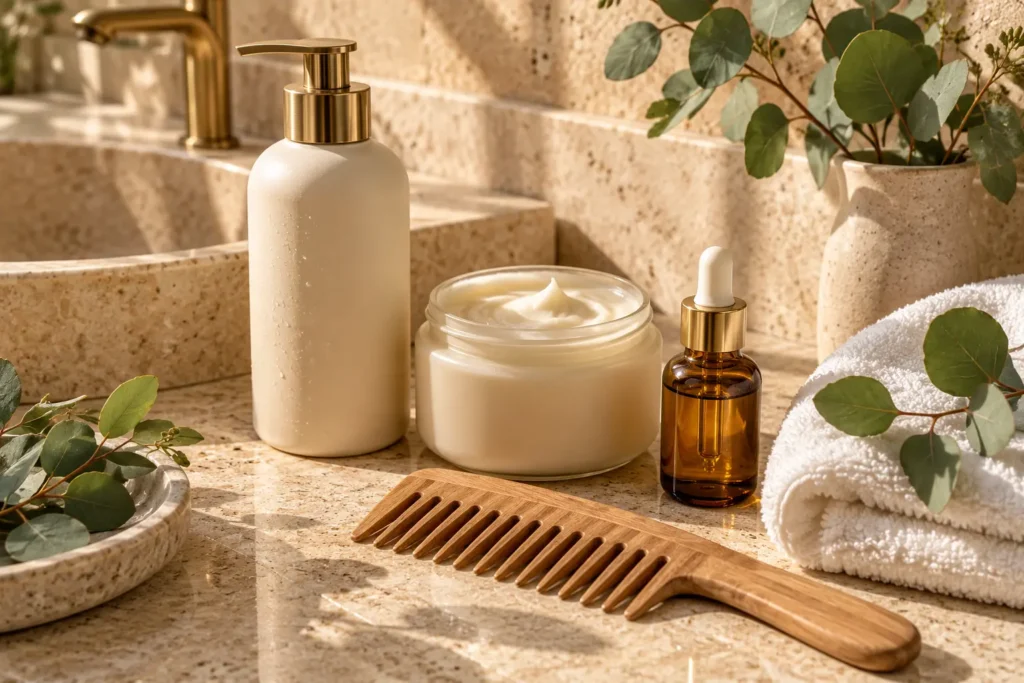
Conditioner is one of the most evidence-supported products for improving the feel and manageability of dry, frizzy hair.
Unlike many marketing claims about permanently repairing damaged hair, the primary function of a conventional conditioner is to improve the surface properties of the hair fiber.
Conditioning agents help reduce friction, improve detangling, and make strands feel softer and smoother.
Many conditioners contain positively charged ingredients, such as cationic surfactants and polymers. These ingredients can adhere to negatively charged areas of weathered hair, helping improve lubrication.
Look for formulations containing ingredients such as:
- Behentrimonium chloride: A conditioning agent that helps reduce friction and improve detangling.
- Cetrimonium chloride: Commonly used to improve softness and manageability.
- Dimethicone: A silicone that can improve slip, shine, and surface smoothness.
- Fatty alcohols: Ingredients such as cetyl alcohol and stearyl alcohol that contribute to conditioning and product texture.
These fatty alcohols should not be confused with simple alcohols such as ethanol. They perform different functions in cosmetic formulations.
Apply conditioner to the mid-lengths and ends, where hair is generally older and has experienced more mechanical wear. Leave it on for the time recommended by the manufacturer before rinsing.
For severely tangled hair, gently detangling while conditioner is present can reduce the force needed to separate strands.
3. Understand What Hair Masks Can and Cannot Repair
Deep conditioning masks can be useful for hair that feels rough, brittle, or difficult to manage, particularly after coloring or frequent heat styling.
However, it is important to distinguish between cosmetic improvement and biological repair.
The visible hair shaft is composed primarily of nonliving keratinized cells. Once the hair fiber has been significantly damaged, it cannot heal itself in the way living skin does.
Conditioning treatments can temporarily improve the appearance and mechanical behavior of damaged hair by depositing ingredients on the surface or, depending on their chemistry, interacting with parts of the fiber.
Hair masks commonly contain higher concentrations of conditioning agents, oils, and film-forming ingredients than lightweight conditioners, although this varies by product.
A weekly mask may be helpful if your regular conditioner is not providing enough softness or detangling. However, there is no universal scientific requirement to use a hair mask every seven days.
Choose the frequency according to how your hair responds rather than following an arbitrary schedule.
4. Apply Leave-In Conditioner to Reduce Friction and Improve Manageability
Leave-in conditioners can provide additional lubrication after washing, particularly for long, curly, chemically treated, or easily tangled hair.
Unlike rinse-out conditioners, leave-in products remain on the hair and continue providing surface conditioning between washes.
Their benefits depend on the ingredients used, but many contain silicones, cationic polymers, fatty compounds, and other film-forming substances.
Apply the product to damp hair, distributing it evenly through the lengths.
For fine hair, a lightweight spray may be easier to use without creating an overly coated appearance. Thicker creams may be better suited to coarse or tightly curled hair that benefits from additional lubrication.
The key is using enough product to improve manageability without unnecessary buildup.
5. Use Hair Oils Strategically Rather Than Treating Them as a Cure
Hair oils are widely recommended for dryness and frizz, but different oils behave differently on the hair fiber.
Some mainly coat the surface, improving lubrication and shine. Others can penetrate the hair to varying degrees.
One frequently cited study published in the Journal of Cosmetic Science in 2003 compared coconut oil, sunflower oil, and mineral oil for their ability to reduce protein loss from hair.
The researchers found that coconut oil reduced protein loss in the tested hair samples when used before or after washing, while sunflower and mineral oils did not show the same effect under those experimental conditions.
The authors associated coconut oil’s performance with its chemical composition and affinity for hair proteins.
However, this does not mean coconut oil is the best treatment for every type of frizz, nor does it establish that all hair oils can reverse existing damage.
How to Use Oils Effectively
A small amount of a suitable hair oil or serum can improve shine and reduce friction along dry ends.
Coconut oil may also be used as a pre-wash treatment if your hair responds well to it.
Avoid assuming that a longer application time or larger quantity will automatically produce better results. Excess oil can make hair difficult to cleanse and may leave fine hair looking weighed down.
If you have a sensitive scalp or a scalp condition, avoid applying unfamiliar oils directly to the scalp without considering possible irritation.
6. Reduce Heat Damage Before Trying to Control Frizz
Heat styling is a major source of avoidable hair damage.
Hair dryers, flat irons, and curling tools expose hair fibers to elevated temperatures. Depending on temperature, duration, moisture content, and the condition of the hair, this exposure can damage the cuticle and alter the physical properties of the fiber.
Repeated high-temperature styling can contribute to increased roughness, breakage, and loss of manageability.
Dermatological guidance from the American Academy of Dermatology recommends limiting heat exposure, using lower settings, and reducing how frequently hot styling tools are used.
A Safer Heat-Styling Approach
Allow hair to partially air dry before using a blow dryer when practical. Use a lower temperature setting and avoid concentrating heat on one section for prolonged periods.
Apply a heat-protective styling product according to its directions, particularly before blow-drying or using hot tools.
Heat protectants may reduce some heat-related damage, but they do not make hair immune to high temperatures.
Never assume that using a protective spray makes repeated exposure to extreme heat harmless.
7. Change the Way You Towel-Dry Your Hair
Mechanical damage is an overlooked contributor to frizz.
Wet hair can be especially vulnerable to stretching and damage during rough handling. Vigorous rubbing with a towel creates friction between fibers, increasing tangling and potentially contributing to cuticle wear.
Instead, gently press or squeeze excess water from your hair.
A soft cotton T-shirt or microfiber towel may be useful because it can absorb water without requiring aggressive rubbing. However, evidence does not establish that microfiber is universally superior to every conventional towel.
The most important factor is reducing unnecessary friction.
Avoid twisting your hair tightly inside a towel, particularly when the strands are already fragile or heavily processed.
8. Detangle According to Your Hair Texture
There is no single brushing technique that works best for every hair type.
Straight hair may be easier to detangle after it has dried somewhat, whereas tightly curled or coily hair is often easier to detangle when damp and coated with conditioner.
The American Academy of Dermatology advises minimizing unnecessary brushing and handling hair gently to reduce damage.
Begin detangling near the ends and gradually work upward, rather than pulling a brush forcefully from the roots through knots.
Use a wide-tooth comb, flexible detangling brush, or your fingers depending on your texture and preferences.
The goal is to reduce pulling forces and avoid repeated mechanical stress.
9. Manage Humidity With the Right Styling Products
Humidity-related frizz can occur even when hair is adequately conditioned.
Hair fibers interact with moisture in the surrounding environment. When humidity changes, water absorption can influence the shape and behavior of the fiber.
This is particularly noticeable in hair that has been straightened or styled into a shape different from its natural pattern.
Anti-humidity styling products often use film-forming polymers, silicones, and other ingredients that help maintain styling alignment or reduce moisture-related changes.
These products cannot completely prevent hair from interacting with atmospheric moisture, but some formulations can improve style retention.
For curly hair, a styling gel or cream that provides hold may be more effective than oil alone because it helps maintain curl grouping and reduces the separation of individual strands.
10. Protect Hair From Friction While Sleeping
Nighttime friction can contribute to tangling, especially in long, curly, or fragile hair.
When hair repeatedly rubs against bedding, strands may become tangled or lose their styled alignment.
Satin or silk pillowcases are popular because their smoother surfaces may reduce friction compared with some rougher fabrics.
However, high-quality clinical evidence directly demonstrating that silk pillowcases prevent hair damage is limited.
A loose braid, relaxed protective hairstyle, or soft hair covering may also help reduce tangling.
Avoid tight overnight hairstyles that place continuous tension on the hairline.
11. Trim Damaged Ends Without Expecting Faster Hair Growth
Split ends develop when the hair fiber becomes physically damaged and begins separating at the tip.
Conditioners and styling products may temporarily make split ends less visible, but they cannot permanently restore the original intact structure.
Trimming removes the damaged portion and may reduce tangling associated with rough ends.
However, trimming does not directly accelerate hair growth because hair grows from follicles within the scalp, not from the ends of the hair shaft.
There is also no universal rule requiring everyone to trim their hair every six or eight weeks.
The appropriate interval depends on hair length, damage, styling habits, and personal preferences.
12. Recognize When Dryness May Need Medical Attention
Most cases of frizz can be managed through cosmetic care and changes in styling habits. However, persistent hair or scalp symptoms should not automatically be attributed to insufficient moisture.
Seek advice from a dermatologist if you experience sudden changes in hair texture, unexplained hair loss, significant breakage, persistent scalp itching, scaling, or inflammation.
Certain medical conditions, nutritional deficiencies, and scalp disorders can affect hair health, and they cannot be reliably diagnosed from appearance alone.
A dermatologist can help distinguish routine cosmetic dryness from an underlying issue that requires specific treatment.
A Practical Dry Frizzy Hair Care Routine
The following routine brings together the most useful recommendations from dermatology guidance and hair cosmetic research. It is designed to reduce avoidable damage while improving softness, detangling, and styling control.
Step 1: Cleanse the scalp
Use a shampoo suited to your scalp’s oil production. Massage the scalp gently with your fingertips and avoid aggressively rubbing the lengths.
Step 2: Condition and detangle
Apply conditioner after shampooing. Gently work through tangles, beginning at the ends. Rinse according to the product instructions.
Step 3: Remove excess water
Blot or squeeze rather than rub. Avoid tightly twisting wet hair or pulling at knots.
Step 4: Apply leave-in conditioner
Distribute a small amount through the lengths. Choose a lightweight or richer formulation depending on your hair’s texture and response.
Step 5: Style with minimal damage
Air dry when practical, or use controlled heat and a heat-protective product. For curls, use an appropriate styling product to maintain definition.
On non-wash days, avoid unnecessarily repeating the entire routine. If the ends feel rough, a small amount of leave-in conditioner or smoothing serum may be sufficient. If the scalp becomes oily or develops significant buildup, cleansing is more useful than applying additional oils.
Common Frizzy Hair Mistakes That Can Make Dryness Worse
One of the most common mistakes is treating every instance of frizz as a sign that hair needs more moisture. Frizz can result from damage, humidity, static, natural texture, or a combination of factors. Adding layers of heavy oils will not necessarily address the underlying problem.
Another mistake is avoiding all silicones because they are assumed to be harmful. Research reviews describe their ability to reduce friction and improve shine. Some silicone-containing products can accumulate with repeated use, but that does not make the entire ingredient category unsuitable for dry hair.
PMC
+1
Similarly, applying excessive heat to make hair appear temporarily smooth can gradually worsen the damage that contributes to frizz. Repeated brushing, rough towel drying, and tight hairstyles may also increase mechanical stress.
A more effective approach is to identify the dominant problem. Hair that tangles easily may benefit from better conditioning and detangling techniques, while humidity-related frizz may respond better to styling products that improve hold.
How Long Does It Take to Improve Dry, Frizzy Hair?
Some improvements can be noticeable after a single wash and conditioning session. Hair may feel softer, detangle more easily, and appear shinier because conditioning ingredients improve its surface properties.
Long-term improvement is different. Reducing heat, friction, and harsh chemical processing helps prevent additional damage, but it does not instantly reverse damage already present in older hair.
There is no reliable universal timeline for achieving smooth hair. Results depend on the severity of damage, natural hair texture, product formulation, environmental conditions, and consistency.
The most realistic goal is progressively better manageability and less avoidable breakage, rather than expecting naturally textured hair to become permanently straight or completely free of flyaways.