By the end of summer, your skin may appear dull yet unusually oily. Frequent sun exposure, heat, sweat, travel, and layers of water-resistant sunscreen can contribute to dehydration, clogged pores, uneven tone, and increased sensitivity.
An end-of-summer skincare routine to reset sun-stressed skin should focus on recovery rather than aggressive correction. Begin by calming irritation and restoring the moisture barrier, then gradually introduce one targeted treatment for concerns such as rough texture, congestion, or discoloration.
Short Answer
Start with five to seven days of gentle cleansing, barrier-supporting moisturizer, and broad-spectrum SPF 30 or higher. Once stinging, redness, and tightness settle, add either a mild exfoliant or a low-strength retinoid—not both together. Expect hydration to improve quickly, while dark spots and rough texture need several weeks or longer.
What Sun-Stressed Skin Actually Looks Like
Sun-stressed skin isn’t a medical diagnosis. It’s a useful way to describe the mix of dehydration, irritation, uneven pigmentation, congestion, and roughness that often becomes noticeable after months of heat and UV exposure.
Your skin may feel tight after cleansing but oily by lunchtime. Makeup might catch around the mouth while sliding off the T-zone. Freckles and existing dark spots can look stronger, and products that felt fine in spring may suddenly sting.
A tan isn’t proof that your skin is healthier, either. Tanning is a response to UV exposure, and no topical routine can erase that exposure. Skin care can support the barrier and reduce the appearance of some visible changes, but it can’t fully reverse accumulated sun damage.
End-of-Summer Skincare Routine to Reset Sun-Stressed Skin
Step 1: Pause the “Corrective” Products for Several Days
For the first five to seven days, set aside scrubs, peel pads, strong acids, retinol, cleansing brushes, and highly fragranced products. If your skin is actively sunburned, tender, peeling, or hot, keep them paused until it feels completely normal.
This short break matters because irritated skin loses water more easily. Adding more exfoliation may briefly make the surface look smoother, but it can prolong tightness, redness, and sensitivity underneath.
I once tried to fix post-vacation roughness with an acid toner three nights in a row. My skin looked polished for a day, then became so reactive that even plain moisturizer stung. A boring week would have worked faster.
Watch Out: Don’t exfoliate peeling sunburn. Those loose flakes are injured skin cells, not ordinary buildup that needs help coming off.
Step 2: Clean Without Leaving Skin “Squeaky”
Use a fragrance-free, low-foaming cleanser at night. Massage it over damp skin for about 30 seconds, concentrating around the hairline, nose, and jaw where water-resistant sunscreen tends to linger.
If you wear heavy makeup or several layers of sunscreen, start with a gentle cleansing balm or oil and follow with your regular cleanser. Double cleansing helps remove film; it shouldn’t mean washing twice with a harsh foaming formula.
In the morning, oily skin may benefit from a light cleanse. Dry or sensitive skin often does better with a lukewarm-water rinse. That slightly slippery feeling after rinsing isn’t dirt—it may simply mean you haven’t stripped away every bit of protective oil.
Step 3: Rehydrate in Thin, Simple Layers
Apply a hydrating serum or essence to lightly damp skin. Look for glycerin, panthenol, beta-glucan, or hyaluronic acid in a fragrance-free formula. You don’t need all four.
Humectants attract water, but they aren’t a complete moisturizer. In dry indoor air, a hyaluronic acid serum can leave skin feeling tighter if nothing seals it in. Follow within a minute with moisturizer rather than waiting for the serum to dry completely.
Skip long “skin flooding” routines while your face is reactive. Five watery layers create five opportunities for fragrance, plant extracts, or preservatives to irritate already-unsettled skin.
Step 4: Rebuild the Barrier With the Right Moisturizer
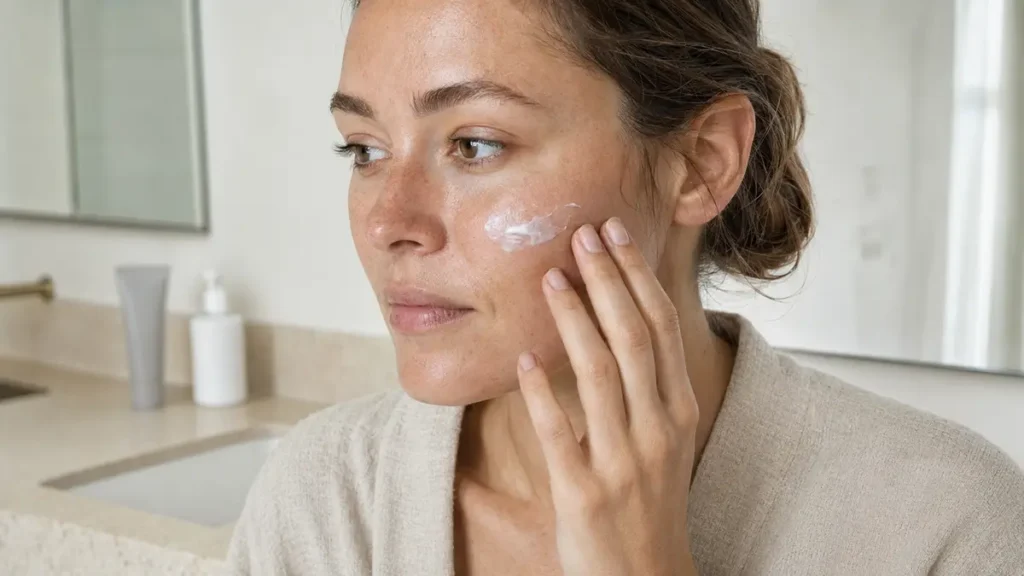
Choose a moisturizer containing a mix of humectants, emollients, and barrier-supporting lipids. Ceramides, glycerin, squalane, fatty acids, and cholesterol are useful label terms.
A gel-cream may be enough for oily or acne-prone skin. Dry skin usually needs a cream, especially around the cheeks and mouth. If your face feels greasy yet tight, apply a light lotion all over and add a richer cream only to dry areas.
Very heavy ointments can reduce water loss, but they’re not automatically better. On hot, inflamed skin, a thick occlusive layer can feel uncomfortable and trap heat. Save ointment for small, dry patches once the skin has cooled.
Pro Tip: Apply moisturizer before your face is bone-dry. A pea-to-almond-sized amount spreads more evenly over slightly damp skin and helps hold that water at the surface.
Step 5: Keep Sunscreen as the Nonnegotiable Treatment
Use a broad-spectrum, water-resistant sunscreen with SPF 30 or higher every morning. Apply it after moisturizer and before makeup. The American Academy of Dermatology also recommends applying sunscreen before outdoor exposure and protecting any uncovered skin.
Use enough to create an even film over the face, ears, neck, and chest. Reapply during prolonged outdoor time, especially after sweating or swimming. Hats, shade, and clothing still matter because sunscreen isn’t a force field; the FDA recommends combining it with other sun-protection measures.
If dark marks are your main concern, consider a tinted sunscreen containing iron oxides. The tint can also reduce the gray or white cast some mineral formulas leave, making it easier to apply the proper amount consistently.
Step 6: Choose One Treatment Based on What You See
After your skin has been comfortable for at least several days, choose one treatment lane. Don’t introduce an exfoliant, retinoid, and brightening serum in the same week—you won’t know which product helped or which caused irritation.
For rough, congested skin, try a leave-on exfoliant once weekly. Salicylic acid works inside oily pores, while lactic acid or a polyhydroxy acid may feel gentler on a dry surface. Avoid grainy scrubs, which make pressure and exfoliation difficult to control. The AAD notes that improper exfoliation can do more harm than good.
For uneven tone or lingering dark marks, consider azelaic acid or niacinamide. Both can fit into a morning or evening routine, but low-to-moderate strength formulas are often easier to use consistently than aggressive “maximum strength” versions.
For fine lines, persistent texture, or acne, a low-strength retinol used at night can help over time. Apply a pea-sized amount to the entire dry face one or two nonconsecutive nights per week. Follow with moisturizer, or place retinol between two thin layers of moisturizer if you’re sensitive.
Good to Know: An exfoliant gives faster surface smoothness, while a retinoid works more gradually on cell turnover and collagen support. Using both aggressively doesn’t double the results; it usually doubles the irritation.
Step 7: Increase Frequency Only When Skin Stays Comfortable
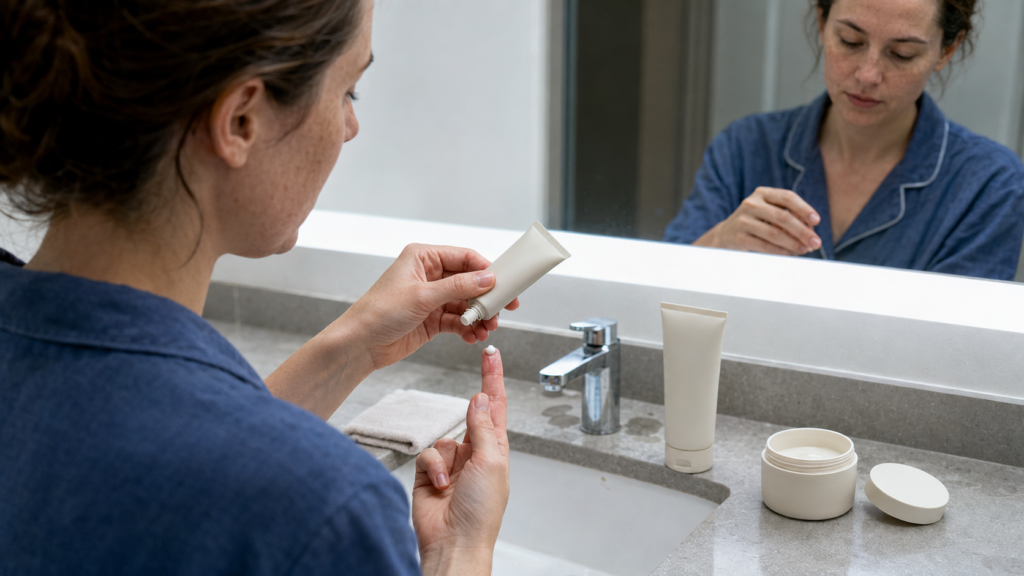
Hold your chosen active at the same frequency for two to three weeks before increasing it. Mild dryness can happen with retinol, but burning, swelling, shiny tight skin, or persistent peeling means your routine is moving too quickly.
Use acids and retinoids on separate nights if you eventually want both. Pair either one with a plain cleanser and moisturizer rather than another treatment-heavy formula.
Patch test new products along the jaw or behind the ear for several days. A patch test can’t predict every breakout, but it can catch obvious irritation before you spread a product over your whole face.
A Simple Morning and Evening Schedule
Morning
- Rinse or use a gentle cleanser.
- Apply a hydrating or niacinamide serum if needed.
- Use a light, fragrance-free moisturizer.
- Finish with broad-spectrum SPF 30 or higher.
Evening on Recovery Nights
- Remove makeup and water-resistant sunscreen.
- Cleanse gently.
- Apply a hydrating serum to damp skin.
- Seal with moisturizer.
Evening on Treatment Nights
- Remove makeup and sunscreen.
- Cleanse and let skin dry.
- Apply your exfoliant or a pea-sized amount of retinol.
- Follow with moisturizer.
This end-of-summer skincare routine to reset sun-stressed skin works because recovery nights remain part of the plan. They’re not “empty” nights; they give your barrier time to tolerate the product you’re asking it to use.
What Results Can You Realistically Expect?
Dehydrated skin may feel more comfortable within several days. Temporary dullness and minor surface roughness can improve over two to four weeks when you moisturize consistently and avoid over-exfoliation.
Dark spots, fine lines, and uneven tone move much more slowly. You may need eight to twelve weeks to judge an at-home treatment fairly, and deeper sun spots may not respond fully to topical products.
The AAD explains that some visible signs of sun damage can improve, but ongoing sun protection remains essential. Without it, new UV exposure can work against the progress you’re trying to make.
See a board-certified dermatologist if a spot changes color, size, shape, texture, bleeds, repeatedly crusts, or looks noticeably different from your other marks. A skin-care routine shouldn’t be used to “fade and wait” on a suspicious lesion.
Adjusting the Reset for Your Skin Type
Oily or Acne-Prone Skin
Don’t skip moisturizer just because your skin feels greasy. Dehydration can coexist with oiliness. Choose a non-comedogenic gel-cream and consider salicylic acid once weekly after the recovery phase.
Dry or Mature Skin
Use a creamy cleanser, a lipid-rich moisturizer, and fewer treatment nights. Lactic acid may suit dry texture better than a strong glycolic peel, but retinol often makes more sense when fine lines are the priority.
Sensitive or Rosacea-Prone Skin
Extend the recovery phase and avoid experimenting with several actives. A mineral sunscreen containing zinc oxide or titanium dioxide may be easier to tolerate if other filters sting. Introduce any new treatment cautiously.
Melanin-Rich Skin
Prioritize irritation control because inflammation can leave or deepen post-inflammatory hyperpigmentation. Gentle, consistent treatment usually beats a strong peel that creates weeks of irritation. Tinted sunscreen can provide useful visible-light protection while avoiding an obvious white cast.